Austria
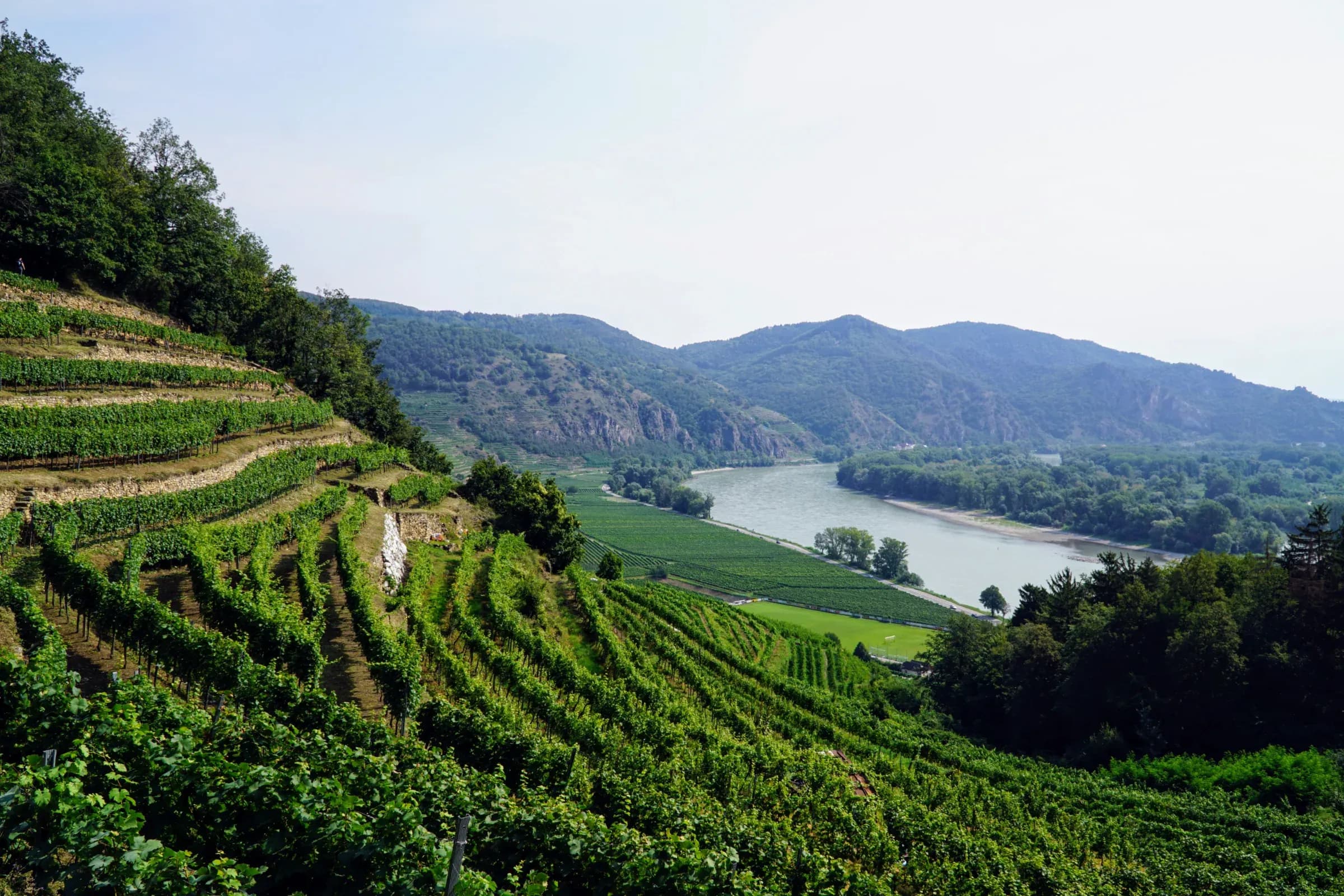
Austria is one of Europe’s most terroir conscious wine countries, built on a strong link between grape variety, soil, and regional origin. It is often thought of first as a white-wine country, and that is statistically correct: Austria had 44,210 hectares under vine in 2023/24, of which 68.4% were planted to white Qualitätswein varieties. Grüner Veltliner alone accounts for 14,296 ha, making it by far the country’s most planted variety; Zweigelt is second at 5,940 ha. Lower Austria dominates fine dry whites, Burgenland is the key zone for red wines and noble rot wines, Styria specialises in incisive aromatic whites, and Vienna remains unique for Wiener Gemischter Satz.
Austria’s modern quality identity is tied to the DAC system (Districtus Austriae Controllatus), which defines regionally typical wines by grape, style, and origin.
1. Overview
Austria’s classic strengths fall into four broad categories:
- Dry, precise whites from the Danube and Lower Austria (especially Grüner Veltliner and Riesling)
- Structured reds from Burgenland (especially Blaufränkisch and Zweigelt)
- Noble-sweet wines around Lake Neusiedl (botrytis-driven styles)
- Aromatic, acid driven whites from Styria (especially Sauvignon Blanc and Muskateller)
2. Climate and terroir fundamentals
Austria sits at the meeting point of several climatic influences:
- Cool continental influence from the north/east supports acidity retention
- Pannonian warmth from the east (Burgenland, eastern Niederösterreich) supports red ripeness and sweet wine concentration
- Danube moderation is crucial in Wachau, Kremstal, Kamptal, and Wagram
- Alpine influence creates large day–night swings, especially on terraces and higher sites
- Styria is wetter and hillier, with stronger fungal pressure and very aromatic white expressions
Southern Burgenland and Styria can see 800–1,200 mm of annual precipitation, which is why canopy discipline and disease management matter more there than in drier eastern sectors.
Useful terms
- DAC: Austria’s origin-and-style system for regionally typical wines
- Gebietswein: regional wine within the DAC hierarchy
- Ortswein: village wine
- Riedenwein: single vineyard wine (Ried = vineyard site)
- Loess: wind-deposited fine silt; deep, fertile, water retentive, and particularly important for Grüner Veltliner
- Pannonian climate: warmer, drier continental influence from the east, especially important in Burgenland
- Botrytis cinerea / noble rot: beneficial fungal concentration, especially around Lake Neusiedl
3. Labelling terms and how to read Austrian bottles
Austria uses two overlapping “languages” on labels: origin (DAC/pyramid) and sweetness / Prädikat terms.
| Term on label | What it means | How to use it when judging style/quality |
|---|---|---|
| Qualitätswein | The core quality category with protected origin (PDO) | Baseline quality tier; includes both dry and sweet wines |
| DAC | Region defined style and origin system | If you know the DAC, you can often predict grape and style |
| Gebietswein | Regional level DAC wine | Typically the most accessible “entry” DAC expression |
| Ortswein | Village level DAC wine | More site-specific; often a step up in concentration/definition |
| Riedenwein | Single-vineyard DAC wine | Most site-expressive; generally the top tier within the DAC pyramid |
| Reserve | A stricter, riper, often more structured expression defined by DAC rules | Usually more intense and fuller, not automatically oaky |
| Wiener Gemischter Satz DAC | Vienna field blend: multiple varieties co-planted and co-harvested | A defining Austrian specialty; layered and savoury rather than a simple blend |
| Sekt Austria | Protected Austrian sparkling category | “Reserve” and “Grosse Reserve” indicate higher ambition and stricter production standards |
4. Austria DAC/PDO quick reference table
| DAC / region | Core grapes / style focus | Typical terrain | Climate signal | Soil signal | Distinctive challenges | Signature outcome |
|---|---|---|---|---|---|---|
| Wachau DAC | Grüner Veltliner, Riesling | Steep Danube terraces | Cool Danube influence, strong diurnals | Primary rock/gneiss, some loess | Terraced viticulture, erosion, frost pockets | Taut, ageworthy dry whites |
| Kremstal DAC | Grüner Veltliner, Riesling | Danube terraces + basin sites | Danube moderation + continental freshness | Loess + primary rock | Balancing loess richness with line | Broad but precise dry whites |
| Kamptal DAC | Grüner Veltliner, Riesling | Valley + terraces | Warm days, cool nights | Loess + gneiss/granite | Ripeness control on warmer sites | Powerful but balanced whites |
| Traisental DAC | Grüner Veltliner, Riesling | Limestone slopes | Cool, ventilated | Limestone/calcareous | Concentration on lighter soils | Fine-boned mineral whites |
| Wagram DAC | Grüner Veltliner | Loess plateau | Warm but freshness retaining | Deep loess | Vigour control, dilution risk | Rounded, spicy Grüner Veltliner |
| Weinviertel DAC | Grüner Veltliner | Rolling landscape | Continental | Loess/clay/sediments | Frost, drought variability | Peppery, fresh Grüner Veltliner |
| Carnuntum DAC | Zweigelt, Blaufränkisch, whites | Low hills/plains | Pannonian warmth | Gravel/loam/loess | Heat/alcohol balance | Ripe but structured reds |
| Thermenregion DAC | Local whites + reds | Hills south of Vienna | Warm, sheltered | Limestone/calcareous mixes | Balancing richness/freshness | Fuller whites, elegant reds |
| Leithaberg DAC | White: Chardonnay/Pinot Blanc etc.; Red: Blaufränkisch | Hills west of Lake Neusiedl | Lake moderation | Limestone + slate in parts | Retaining tension in warmth | Mineral whites, serious Blaufränkisch |
| Mittelburgenland DAC | Blaufränkisch | Rolling hills | Warm Pannonian | Loam/clay | Preserving definition | Dense, structured Blaufränkisch |
| Eisenberg DAC | Blaufränkisch | Southern slopes | Cooler, wetter | Iron rich loam/schist | Disease pressure, ripeness management | Lithe, mineral Blaufränkisch |
| Neusiedlersee DAC | Zweigelt | Plains near lake | Warm + humid fog | Sands/gravel/loams | Humidity/botrytis management | Fruity Zweigelt; sweet wine proximity |
| Südsteiermark DAC | Sauvignon Blanc, Morillon, Muskateller | Steep hills | Cool-humid | Marl/limestone mixes | Fungal pressure, erosion | Aromatic, incisive whites |
| Vulkanland Steiermark DAC | Sauvignon and aromatic whites | Volcanic hills | Warmer Styria | Volcanic | Disease pressure | Spicy, expressive whites |
| Weststeiermark DAC | Schilcher (Blauer Wildbacher) | Steep hills | Cool, wet | Gneiss/schist | Rot pressure, ripening difficulty | High acid rosé speciality |
| Wiener Gemischter Satz DAC | Field blend whites | Urban slopes | Warm urban mesoclimate | Mixed limestone/loess/flysch | Co-ripening decisions | Layered, savoury field blends |
5. Core grapes (key facts distilled)
| Grape | Colour | Structural profile | Primary Austrian homes | Typical hazards | Typical styles |
|---|---|---|---|---|---|
| Grüner Veltliner | White | Medium-high acidity; peppery phenolics | Weinviertel, Wagram, Wachau, Kamptal, Kremstal, Traisental | Vigour on loess; botrytis in wet years | From light DAC wines to dense reserve bottlings |
| Riesling | White | High acidity; linear structure | Wachau, Kamptal, Kremstal, Traisental | Autumn rain, underripeness | Dry, stony, ageworthy wines |
| Blaufränkisch | Black | High acidity, firm tannin, terroir-transparent | Mittelburgenland, Eisenberg, Leithaberg | Hard tannin if underripe | Mineral, spicy structured reds |
| Zweigelt | Black | Softer tannin, juicy fruit | Neusiedlersee, Carnuntum | Overcropping risk | Fruit-forward reds |
| Sauvignon Blanc | White | High aromatic intensity | Südsteiermark, Vulkanland | Pyrazine excess if underripe; fungal pressure | Aromatic, site led whites |
| Welschriesling | White | Bright acidity; neutral base | Burgenland, Neusiedlersee | Dilution at high yields; botrytis susceptibility | Dry light whites, sweet wines, sparkling base |
| Blauer Wildbacher | Black | Very high acidity | Weststeiermark | Rainfall/rot | Schilcher rosé |
| Chardonnay / Morillon | White | Medium body; oak-capable | Styria, Leithaberg | Fungal pressure in wet zones | Mineral still whites; some sparkling |
| Neuburger | White | Lower acidity, savoury breadth | Leithaberg, Thermenregion | Loss of freshness | Textured whites |
| Rotgipfler / Zierfandler | White | Rich texture, moderate acidity | Thermenregion | Need warm sites | Fuller local whites |
| Wiener Gemischter Satz | White field blend | Balanced through co-planting | Vienna | Co-ripening/harvest timing | Layered, savoury dry whites |
6. Sweet wines in Austria (including styles uniquely associated with Austria)
Austria’s sweet-wine system combines Prädikat categories (based on must weight at harvest) with region specific traditions, especially around Lake Neusiedl. The most distinctive Austria specific reference is Ruster Ausbruch, alongside the country’s strength in BA/TBA and its long tradition of botrytis and dried grape sweet wines.
| Style name | What it is | Typical grapes | Core regions | Sensory signature |
|---|---|---|---|---|
| Beerenauslese (BA) | Botrytis selected berries; rich but still fresh | Welschriesling, Chardonnay, others | Neusiedlersee / Seewinkel | Apricot, honey, saffron, bright acidity |
| Trockenbeerenauslese (TBA) | Intensely botrytised “raisined” berries | Welschriesling, Chardonnay, others | Seewinkel | Dried apricot, caramelised citrus, very long sweetness |
| Eiswein | Frozen harvest; no botrytis required | Grüner Veltliner, Riesling, others | Various cool regions (vintage dependent) | Pure fruit, crystalline acidity |
| Ausbruch / Ruster Ausbruch | Historic botrytis sweet style centred on Rust | Often Welschriesling and local blends | Rust / Leithaberg orbit | Botrytis richness with saline/mineral lift |
| Strohwein / Schilfwein | Grapes dried on straw mats or reeds | Welschriesling, Zweigelt, others | Burgenland and beyond | Dried fruit, tea, honey |
| Sweet reds | Dried-grape or concentrated sweet reds | Zweigelt and others | Burgenland | Sour cherry compote, cocoa, spice |
Sweet wine takeaway: Austria’s sweet wine “engine” is the Neusiedlersee / Seewinkel zone (fog + humidity + botrytis), while Eiswein is increasingly vintage dependent.
7. Major regions and style logic
Lower Austria (Niederösterreich)
Austria’s largest region and the core of fine dry whites. The Danube corridor (Wachau, Kremstal, Kamptal, Traisental, Wagram) focuses on Grüner Veltliner and Riesling, with clear soil driven distinctions such as loess generosity versus primary rock tension. Weinviertel DAC remains the large scale reference for peppery Grüner Veltliner typicity.
Burgenland
Austria’s key red wine and sweet wine state. Blaufränkisch defines Mittelburgenland, Eisenberg, and Leithaberg; Zweigelt is central around Neusiedlersee. Lake Neusiedl’s humidity and autumn fog support botrytised sweet wines and create a constant balancing act between rot risk and noble rot opportunity.
Styria (Steiermark)
Aromatic white frontier, wetter and hillier, with strong Sauvignon Blanc presence and intense site expression. The three Styrian DACs (Südsteiermark, Vulkanland Steiermark, Weststeiermark) reflect differences in soil and warmth; Weststeiermark is singular for Schilcher rosé from Blauer Wildbacher.
Vienna (Wien)
A small but globally unique capital city region, defined by Wiener Gemischter Satz DAC: co-planted, co-harvested field blends that are savoury and layered rather than simple blends.
8. Winemaking approaches across Austria
Austrian wineries often aim for precision and terroir transparency:
- Stainless steel and large neutral vessels for Grüner Veltliner and Riesling
- Lees work for texture where needed
- Restrained oak for serious Chardonnay/Morillon
- Careful extraction and moderate oak for Blaufränkisch and top Zweigelt
- Sweet wines handled to preserve acidity and botrytis complexity
Austria also has a strong sparkling segment under Sekt Austria, especially at the Reserve and Grosse Reserve levels.
9. Summary
Austria’s identity is unusually legible: Grüner Veltliner and Riesling dominate the Danube and Lower Austria, Blaufränkisch and Zweigelt define much of Burgenland, Sauvignon Blanc and Schilcher give Styria a distinct aromatic identity, and Vienna’s Gemischter Satz is a true field blend specialty. The DAC framework clarifies regional typicity, while Austria’s sweet wine tradition, especially BA/TBA and the historic Ruster Ausbruch remains one of the country’s most distinctive strengths.
Check your knowledge
Expert quiz